A Yarram Progress Association Project
1. Project Overview
Yarram & District Progress Association (Y&DPA) is exploring options to improve public transport in and around Yarram.
The project is being driven by a wonderful local group of community volunteers with a passionate commitment to finding the best possible solution for our town. We will need quite a few volunteers (drivers, admin people, financial management people etc) to bring a service to life. If you would like to be part of this exciting team, please let us know - you will be most welcome!
It’s a very complex challenge - far more complex than we first thought - and will take some time to work through all the different options and possibilities.
We’ve broken the project into two separate challenges:
How to get the existing V/Line bus service extended to Sale
How to get our own Community Bus to service the local region
2. Extending the existing V/Line service to Sale
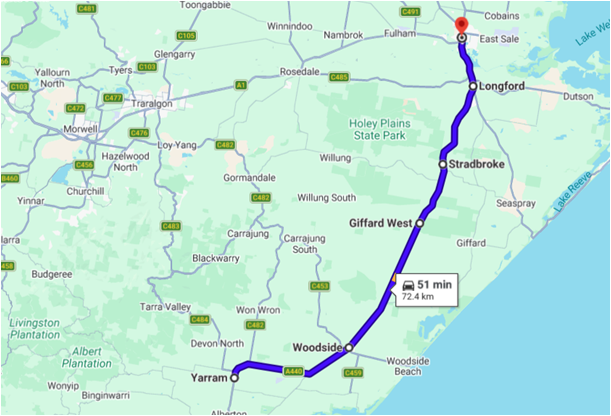
Our team has submitted a formal proposal to the Department of Transport for them to consider how best the existing bus service from Southern Cross to Yarram might be extended to Sale.
You can read the formal proposal here.
Our proposal has been really well supported by our local representatives - Tom McIntosh Member for Eastern Victoria, Danny O’Brien Member for Gippsland South and Cindy Madeley Mayor, Welington Shire Council have all written to Department of Transport to add their support.
Department of Transport have advised that our proposal is under consideration - we await the next steps.
3. Setup and Run a local Community Bus
We have been exploring options to have our own Community Bus - learning from the recent experience of Sandy Point and Venus Bay communities who both embarked on similar projects and have just completed a 2 year pilot project. Sandy Point uses an ‘on demand’ model and Venus Bay is a more traditional ‘scheduled bus route’ approach - so there’s lots of great learnings from their experiences. You can read the report from their project here - it’s well worth a look.
The Scheduled Bus Route model seems to be the best fit for Yarram. The plan is to find a way to help people from the surrounding areas get into Yarram and back home again. We hope to provide a regular community transport service (maybe initially 2–3 days per week) which will connect surrounding townships to Yarram to support access to:
Shopping and essential services
Health and community services
Social and recreational activities
Local businesses and civic participation
Such a service will reduce transport barriers while reinforcing Yarram’s role as a local service centre.
The service will prioritise:
Older people, including those with disability or reduced mobility
Young people accessing education, employment and social activities
Residents experiencing transport disadvantage
Accessibility, safety and affordability will guide service design and vehicle selection.
4. Service Area
Current thinking is that the service will connect Yarram with surrounding communities including:Woodside, Woodside Beach, McLoughlins Beach, Manns Beach, Port Albert, Robertsons Beach, Langsborough, Alberton, Gelliondale, Welshpool, Binginwarri, Staceys Bridge, Jack River, Devon North, Tarra Valley and Carrajung.
5. Integrated Public Transport Connections
A core design principle is alignment with existing regional transport services. Timetabling will:
Coordinate with V/Line bus services to and from Melbourne
Support connections to Traralgon and the regional rail network
Minimise transfer wait times
Enable practical same-day return travel where possible
This approach improves network efficiency and expands mobility options without duplicating existing services.
6. Delivery Approach
Implementation will occur in staged phases:
Phase 1 – Establishment
Community consultation and route design
Coordination with V/Line schedules
Vehicle procurement and accessibility readiness
Phase 2 – Pilot Delivery
Launch of limited weekly services
Monitoring patronage and transfer performance
Continuous stakeholder feedback
Phase 3 – Optimisation and Sustainability
Route and timetable refinement based on demand
Evaluation of service frequency expansion
Development of long-term operational partnerships and funding pathways
7. FLEXIBLE LOCAL TRANSPORT SOLUTIONS PROGRAM
We are working with the Department of Transport under their Flexible Local Transport Solutions (FLTS) program. The program provides Victorian Government funding to local government and community organisations for small-scale transport projects, particularly in regional Victoria.
The program provides financial support to help seed small-scale initiatives across Victoria that address transport disadvantages, integrate with other local transport options, and improve transport access. It may be possible for this fund to pay for a minibus to kick off the project - but we will need to find a way to pay ongoing costs for fuel, maintenance, insurances and other local expenses to keep the service running.
Potential Routes
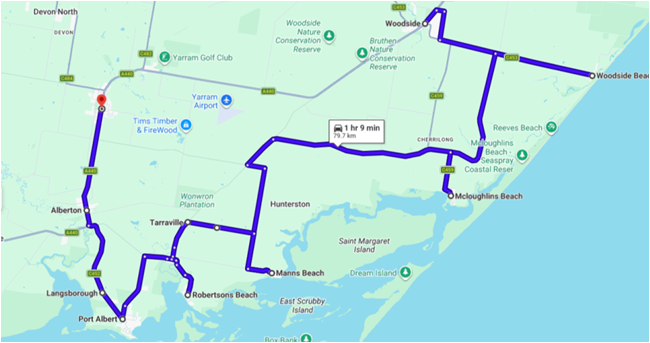
ROUTE 1 - COASTAL
Yarram - Woodside – Woodside Beach – McLoughlins Beach – Manns Beach – Tarraville – Robertsons Beach – Port Albert – Langsborough – Alberton – Yarram
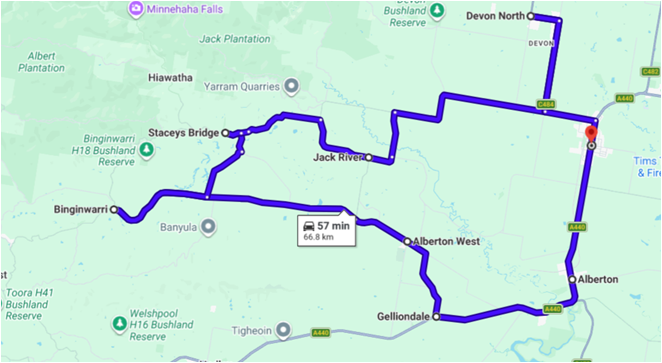
ROUTE 2 – EASTERN HILLS
Yarram – Alberton – Gelliondale – Alberton West – Binginwarri – Staceys Bridge – Jack River – Devon North – Yarram
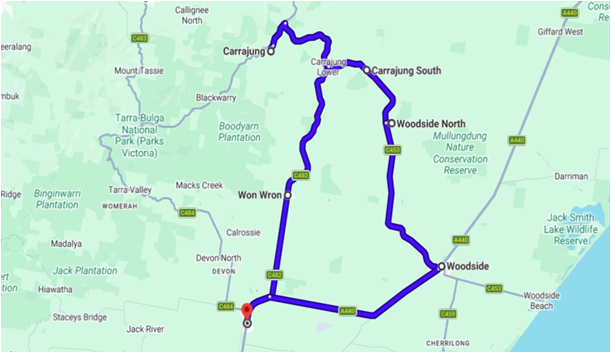
ROUTE 3 – STRZELECKIS
Yarram – Won Wron - Carrajung – Carrajung South – Woodside North – Woodside – Yarram
ROUTE 4 – SALE (If V/Line can’t/won’t extend their service to Sale)
Yarram – Woodside – Giffard West – Stradbroke – Longford – Sale – Yarram